


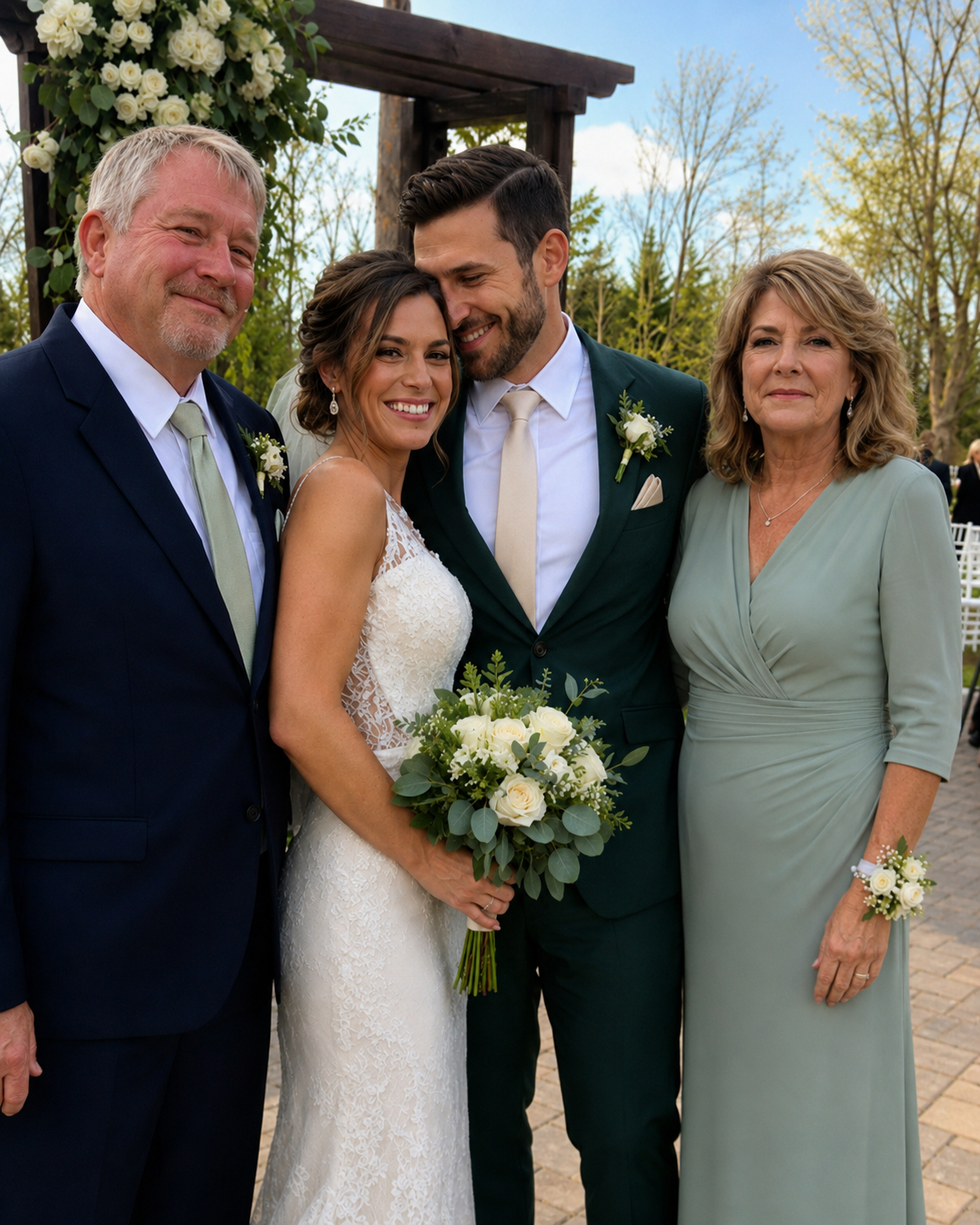
I knew Deborah did not like me long before Russell ever admitted it.
Women like her rarely say hatred plainly. They dress it up in manners, perfume it with politeness, and hand it to you with a smile.
“That dress is very brave of you.”
“You must feel so relieved to finally have some stability.”
“It must be exciting to marry into a family that can open doors.”
She always said things softly enough that if I reacted, I would look dramatic. She smiled when she said them. She tilted her head like she was offering wisdom. And afterward, I would lie awake wondering whether I had imagined the blade.
I had not.
Deborah never wanted me for her son.
Russell came from old money. The kind of money that did not need to introduce itself. The kind with portraits in hallways, family attorneys on speed dial, silverware with initials engraved into it, and relatives who knew exactly which secrets were old enough to be called tradition.
His family home had a name.
Their furniture had history.
Their Christmas dinners came with rules nobody had to say out loud.
I came from my father’s repair shop and a two-bedroom house behind a gas station on Route 9.
My dad, Jimmy, raised me alone after my mother left. He fixed engines by day and packed my lunches at night. He learned how to braid my hair badly, how to sign school forms, how to show up for parent-teacher conferences still smelling faintly of oil and metal because there had been no time to go home and change.
He never once made me feel like we were missing anything.
Even when we were.
So when Russell proposed, I saw the way Deborah looked at my ring.
Not with joy.
Not with surprise.
With suspicion.
As if the diamond on my finger proved something ugly about me instead of something beautiful between us.
Still, I tried.
For three years, I tried.
I sent thank-you notes after every dinner. I invited her to dress fittings twice. I asked her opinion about flowers, even though she chose white roses and then complained about them at every meeting afterward. I smiled through comments that landed too perfectly to be accidental. I told myself that if I was patient enough, gracious enough, careful enough, one day she would see me clearly.
Russell told me to stop trying so hard.
I told him I was raised to try.
That was true.
My father had raised me to fix what could be fixed. To show up. To work quietly. To believe people were more than their worst first impression.
But on my wedding day, I learned that some people are not waiting to understand you.
Some people are waiting for a stage.
The ceremony itself was beautiful.
Dad walked me down the aisle with his jaw set in that stubborn way he has when he is trying not to cry. Halfway down, I felt his hand move briefly toward the inside of his jacket, touching the old leather folder he always carried.
I had seen that folder my entire life.
It was worn at the edges, stretched from years of use, tucked into a custom pocket he had sewn inside his jacket because he never trusted important papers to his truck. Insurance documents. Old receipts. Notes. The occasional photograph. It went everywhere with him.
That day, I barely noticed it.
I was too busy trying not to tremble.
Russell stood at the altar watching me with an expression that made the rest of the world blur. For one hour, I believed we were going to be fine. I believed love could outrun class, money, pride, and all the quiet ways people judge what they do not understand.
Then came the reception.
Two hundred guests filled the ballroom.
Crystal glasses caught the light. White roses climbed the centerpieces. The cake was taller than my niece. The band played something soft while waiters moved between tables carrying champagne and plates no one wanted to spill on expensive clothes.
I was dancing with Dad when Deborah stood.
She picked up the microphone.
Tapped it twice.
The music faded.
The room turned.
She smiled at me.
And something in my stomach dropped before she even opened her mouth.
“I think someone should finally say what we’re all thinking.”
Russell went pale.
I felt Dad’s hand tighten slightly around mine.
Deborah stood at the family table like she had waited all day for this moment, her posture perfect, her voice clear and unhurried.
“This girl did not marry my son for love,” she said. “She married him for our money.”
A ripple of gasps moved through the room.
Someone dropped a fork.
Someone else whispered, “Deborah.”
But she was not finished.
She laughed lightly, as if she had said something clever instead of cruel.
“I suppose spending a few years pretending to be in love is a great deal easier than spending a lifetime working in a repair shop.”
Heat rushed into my face.
The room seemed to tilt.
A few guests looked down at their plates. Others stared at me with the terrible curiosity people wear when they know they are witnessing humiliation but have not decided whether they are brave enough to object.
Deborah smiled at the crowd.
“Some people are very talented at looking grateful.”
That was the moment my chest broke open.
Not because I believed her.
Because I realized how many people in that room might.
I felt sixteen again for one awful second. The girl behind the gas station. The girl with grease under her nails after helping Dad. The girl who learned early that people with money could mistake survival for ambition and humility for shame.
I opened my mouth, but nothing came out.
Then my father let go of my hand.
And stood.
He did not move quickly. Dad never does when he is angry.
He pushed his chair back, straightened his jacket, and looked at Deborah across the ballroom with an expression I knew too well.
Patient.
Honest.
Completely done with pretending.
It was the same look he used when someone brought him an engine they had ignored for too long and expected him to say it was fine.
He walked toward the microphone.
I grabbed his sleeve before he passed me.
“Dad,” I whispered. “Please.”
He covered my hand with his, and when he smiled at me, I felt twelve years old again in the safest possible way.
“Let me talk about my daughter for a minute.”
The room was silent when Dad took the microphone.
Not the polite silence of people waiting for a toast.
The tense silence of people realizing the night had shifted into something they could no longer control.
Dad looked directly at Deborah.
“I’d like to ask you something,” he said calmly. “How much do you actually know about my daughter?”
Deborah lifted her chin.
“I know enough.”
Dad nodded slowly.
“I wonder.”
Then he reached into his jacket and touched the leather folder. The one he had carried for as long as I could remember.
But he did not open it yet.
“Let me tell you about when Orra was sixteen,” he said.
My breath caught.
“When our neighbor, Mrs. Evelyn, got her diagnosis, she was raising her young grandchildren alone. Those children had already lost both of their parents in a car accident. Her husband had been gone for years. And when the insurance company finally came back with what they would cover, it was not nearly enough.”
I looked across the ballroom.
Mrs. Evelyn was sitting quietly at Dad’s table, small and white-haired, with the careful posture of someone who had once been taller. I had hugged her earlier and moved on because there had been a hundred wedding things demanding my attention.
Now every eye in the room turned toward her.
Dad continued.
“I remember finding Orra sitting on the kitchen floor that night. I thought something had happened to her. She was crying because she could not understand how someone could do everything right and still end up losing everything.”
The ballroom became the quietest place with two hundred people I had ever heard.
Dad glanced toward Deborah.
“You mentioned the repair shop,” he said. “You’re right. Orra worked there. She worked there after school. She babysat on weekends. She cleaned offices on nights when we did not have a job. And I want you to know what for.”
Then he opened the leather folder.
Inside were papers I had not seen in years.
Receipts.
Payment confirmations.
Handwritten notes in my own teenage handwriting.
Donation records with my name printed across the top.
My heart stopped.
“Not for a car,” Dad said. “Not for clothes. Not for jewelry. Not for college parties.”
He lifted the first receipt.
“Every paycheck she earned for two years went into an envelope for Mrs. Evelyn’s treatments and her grandchildren.”
My throat tightened so sharply I could barely breathe.
I had not thought about that envelope in years.
I had not wanted anyone to know then. I had been sixteen and angry at the unfairness of the world, and the only thing I could do was work. So I worked. After school. Weekends. Nights. I gave what I could, and Dad had found out only after months of wondering why my shoes were falling apart and I still refused to buy new ones.
Deborah’s voice cut across the room, but it was thinner now.
“That’s ridiculous. You expect two hundred people to believe that?”
Dad looked at her.
Then he held up the folder.
“No. The receipts can do that.”
He passed the first stack to the nearest table.
The papers began moving through the room.
Slowly at first.
Then with urgency.
People leaned over them. Read names. Dates. Amounts. Notes. My old handwriting.
I stood frozen at the edge of the dance floor while strangers held proof of a part of my life I had never wanted applause for.
Dad looked at Deborah one last time.
“If Orra wanted money,” he said, “she chose the slowest possible way to get it.”
A few people lowered their heads.
Then Dad said the sentence that made Deborah’s face go pale.
“Character doesn’t come with a bank account. I’d have thought a family like yours would know that by now.”
He set the microphone down.
Then walked back toward me.
No one moved.
I was still trying to remember how to breathe when Russell stood.
His chair scraped softly against the floor, but in that silence, it sounded like thunder.
“I knew,” he said.
The room turned to him.
Russell looked at me from across the ballroom with an expression I recognized slowly. It was the same look he had worn the morning he told me he loved me for the first time.
Slightly wrecked.
Completely certain.
“A couple of years ago, a storm hit the shop,” he said. “I was helping Jimmy clean out the back room, and I found the envelope.”
He glanced at Dad, who nodded once.
“Jimmy told me the whole story.”
Russell looked back at me.
“That was the day I decided to ask you to marry me.”
Tears filled my eyes.
“Not because you helped someone,” he said. “Because you never needed anyone to know that you had. Not me. Not anyone. We had been together two years, and you had never said a word. I had to find out from an envelope in the back room of a repair shop during flood cleanup.”
His voice cracked slightly.
“That is who she is, Mom.”
Then he turned to Deborah.
“That is exactly who she is.”
Somewhere near the back of the room, someone began crying quietly.
Deborah still stood beside the microphone, but something had shifted in her face. The certainty was gone. The polished cruelty had drained out of her, leaving behind a woman who looked, for the first time all day, unsure of where to put herself.
But Dad was not finished.
He turned toward his table.
“Mrs. Evelyn,” he said gently.
The small white-haired woman set down her glass.
She stood slowly, straightening herself to her full height, which was not very tall but suddenly felt entirely enough.
The entire room watched her.
The woman nobody had been paying attention to all evening.
She looked at me, and her eyes were wet.
“I was told I had about a year,” Mrs. Evelyn said.
Her voice was soft, but in that ballroom, it carried.
“That was eleven years ago.”
A quiet sound moved through the room.
She smiled faintly.
“I have four grandchildren I would not have raised. I watched one of them graduate from college last spring. I planted a garden twice. I got a dog named after a president, and he is very spoiled and absolutely worth it.”
A few people laughed through tears.
Then she looked at me directly.
“And I have a young woman who never once let me thank her properly because every time I tried, she changed the subject.”
My lips trembled.
Mrs. Evelyn’s voice broke.
“You gave me eleven years, sweetheart. I have been trying to give them back ever since.”
Then she sat down.
I do not know what the room sounded like after that because I stopped hearing it clearly. I know people were crying. I know someone began clapping, softly at first, then others joined. I know Russell came to my side, though I did not remember seeing him cross the room.
My father stood nearby, watching me the way he always did when something big happened.
Quietly proud.
Not needing credit.
Not needing applause.
Deborah remained standing.
But she no longer looked powerful.
She looked like a woman who had arrived somewhere she had never intended to go.
The rest of the reception continued somehow, though nothing felt the same after that. People came up to me with tears in their eyes. Some apologized even though they had not said anything. Others thanked Dad. Mrs. Evelyn held my hands for a long time and said nothing, because by then both of us were crying too hard to form a decent sentence.
Deborah did not approach me that night.
I was grateful.
Four days later, she came to the repair shop.
I was helping Dad sort through paperwork, which is something I do badly and he appreciates anyway, when the bell above the door rang.
I looked up expecting a customer.
Instead, Deborah stood there in a cashmere coat that probably cost more than our monthly shop insurance. She looked at the oil-stained floors, the engine parts, the wall of tools, the photographs Dad had pinned behind the register, and for once, she did not look as if she were judging the place.
She looked as if she were finally seeing it.
Dad offered her coffee from the old machine in the corner that always makes it too strong.
Deborah accepted.
That surprised me.
Then she apologized.
Not a short apology.
Not the kind that explains itself into innocence.
Not the kind that tries to make the injured person comfort the one who caused the wound.
A real apology.
Measured.
Difficult.
Heavy with the memory of what she had said in front of two hundred guests.
She said she had been cruel. She said she had judged me because it was easier than admitting she had been afraid of losing control. She said she had mistaken money for protection and polish for character.
Dad accepted the apology the way he accepts most things.
Calmly.
Without making a performance of it.
I accepted it too.
Not because it erased what she had done.
Because I did not want to carry her shame for her.
She stayed about twenty minutes.
She looked at the framed birthday card I had made Dad when I was seven, the one he kept because he said the drawing looked exactly like the car he had been fixing at the time. She looked at my old certificates, the photographs of me at different ages, Dad’s hands in nearly every frame, always oil-stained, always somewhere nearby.
On her way out, Deborah turned back.
This time, when she looked at me, there was something in her eyes I had never seen before.
Respect.
“Why didn’t you ever tell anyone?” she asked. “About Mrs. Evelyn. Any of it.”
I thought about that for a moment.
Then I gave her the only answer I had.
“The good things you do don’t stop being good just because nobody sees them.”
Deborah nodded once.
Then she left.
Through the shop window, Dad watched her drive away with his hands in his pockets. Then he looked over at me and smiled in that quiet way of his, the kind that means he is proud but does not need to say it out loud because he knows I already know.
There is a photograph from the wedding that Russell’s best man took without anyone noticing.
Dad is sitting at his table just after Mrs. Evelyn finished speaking. His leather folder is in his hands. He is looking across the ballroom at me.
Russell framed it.
It hangs in our hallway now.
Sometimes people ask about it, and I tell them only that it was taken at the moment my father reminded a room full of rich people what wealth actually looks like.
That is the thing about being raised by a man who fixes things patiently, without complaint, behind a gas station on Route 9.
You learn that the most important work is almost never the work anyone sees.
You learn that love is not loud.
That sacrifice does not always announce itself.
That dignity does not need diamonds.
And that a person’s worth is not measured by the house they came from, the dress they wear, or the last name they marry into.
Sometimes the richest person in the room is the one holding an old leather folder full of receipts.
Sometimes the most powerful speech is given by a father who never raised his voice.
And sometimes, the truth only needs one quiet man to stand up before an entire room finally goes silent.
