


PART 2
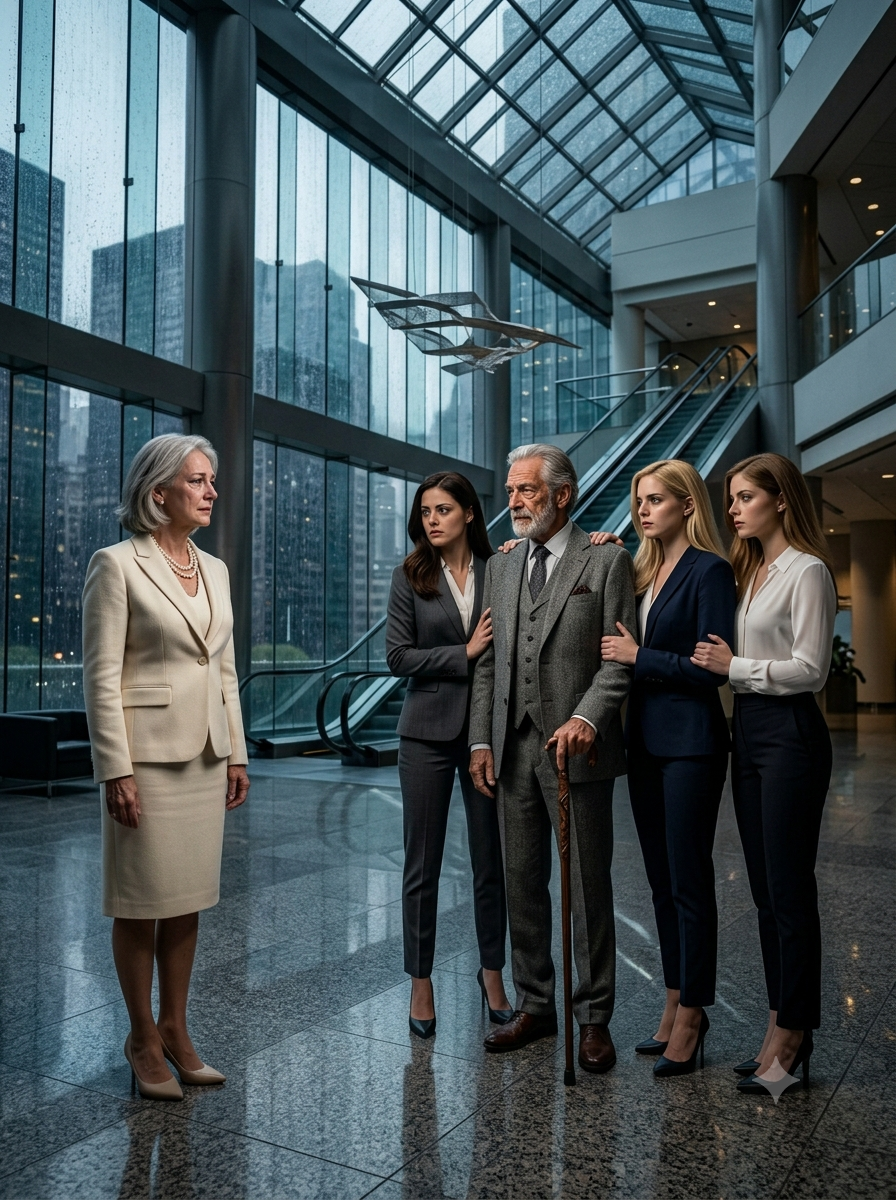
For a brief moment, the only noise filling the atrium was the gentle patter of rain striking the glass ceiling overhead.
Hundreds of people occupied the space beneath the soaring roof of Navarro Global’s newly unveiled Manhattan headquarters—investors dressed in tailored suits, journalists with cameras at the ready, employees wearing silver identification badges, scholarship recipients from neighborhoods where Rafael had once worked, and longtime friends gathered to celebrate what felt less like a corporate opening and more like a tribute to a remarkable life.
At the heart of it all stood Marisol Navarro.
She was no longer the woman Rafael carried in his memories.
The Marisol he remembered had worn hand-me-down sweaters with frayed cuffs. She fastened her hair with ribbons because proper clips were an unnecessary expense. Back then, she laughed freely and loudly, before laughter faded from their small kitchen, before unpaid bills settled between them like silent accusations.
The woman before him wore a cream-colored suit so immaculate it seemed incapable of creasing. Her dark hair, sleek and glossy, was touched with silver that appeared intentionally placed. A strand of pearls rested gracefully around her neck. Her lipstick carried the faded shade of antique roses.
Yet her eyes had not changed.
Rafael recognized them before she spoke again.
Ava, Carmen, and Sophie remained together on the stage, still facing the audience. Only minutes earlier, they had been smiling beside their father while photographers documented the ribbon-cutting ceremony. Now the ribbon lay abandoned near their feet, its vivid blue ends curling across the polished floor.
Ava moved first.
She descended from the stage at an unhurried pace, not out of fear but with the disciplined restraint of someone accustomed to thinking before reacting. Older than her sisters by four minutes, she had always treated that distinction like a quiet duty. Her expression stayed controlled, though Rafael noticed the faint tightening along her jaw.
“Who let you in?” Carmen asked.
Her voice was not raised, yet it carried through the room.
Carmen, who could win over a room full of investors before breakfast and debate multiple strategies simultaneously, had become perfectly still. Her confidence had not disappeared; it had transformed into something fiercely protective.
Marisol offered a faint smile, as though the question had been expected.
“I was invited by circumstance,” she said. “And by blood.”
Sophie released a soft laugh devoid of humor. “Blood didn’t feed us.”
A ripple of murmurs spread through the crowd. Several reporters lifted their phones higher. One of Navarro Global’s security directors stepped forward, but Ava raised a hand without turning toward him.
“No one touches her,” Ava said.
Marisol’s smile deepened ever so slightly.
Rafael suddenly wished with all his heart that the room contained no one else. Not because of shame—he had outlived that long ago—but because whatever had brought Marisol back belonged behind closed doors rather than in front of cameras. It deserved a kitchen table and honest conversation. It deserved truth.
But truth rarely arrived gently.
Marisol turned toward the audience as though addressing a corporate board.
“My name is Marisol Navarro,” she announced. “I am the mother of Ava, Carmen, and Sophie Navarro. Thirty years ago, I was forced from a life I could no longer endure. I made difficult choices. Choices no one here has the right to judge.”
Something shifted in Carmen’s expression.
Rafael noticed it immediately—the fleeting spark of hurt beneath her anger. Carmen had spent her entire life pretending the missing half of her story did not matter. At twelve, she had once told Rafael that mothers were like fairy tales—pleasant for other children but unnecessary for her.
Yet later that same night, he had found her lying awake, crying silently into her pillow.
Marisol continued speaking.
“I have watched my daughters build something extraordinary. I am proud of them. But I am also entitled to recognition for the life I gave them. For the sacrifices that began with me. I have come to request—formally and publicly—a settlement of one billion dollars.”
The silence grew heavier.
One billion dollars.
The figure felt too enormous to belong to a family’s pain. It belonged to financial markets, mergers, and governments—not to a woman standing only twenty feet from the daughters she had abandoned.
Ava studied her for several long seconds.
Then she asked, “You came to a public event to demand money?”
“I came because private letters were ignored.”
Ava’s eyes narrowed.
Rafael turned slightly. “Letters?”
For the first time, Marisol looked directly at him.
There it was—a hesitation. Small, but unmistakable.
“You look older, Rafael,” she said.
He offered a sad smile. “Thirty years will do that.”
For an instant, her composure nearly slipped.
“I wrote to the company’s legal department,” she said.
Carmen looked toward their general counsel, Daniel Cho, who stood near the front row wearing a grim expression. Daniel adjusted his glasses.
“We received communications from an attorney representing a woman claiming maternal relationship,” he said carefully. “The claim was assessed as unverified. Given the threats of media exposure included in the letters, we categorized them as potential extortion attempts.”
Color rose in Marisol’s cheeks. “I asked to be heard.”
“You asked for a billion dollars,” Sophie said.
“I asked for what was fair.”
“What did you think would happen?” Carmen asked. “We’d cry, run into your arms, and sign a wire transfer?”
A flash of irritation crossed Marisol’s eyes. “I did not come here to be mocked.”
“No,” Ava said quietly. “You came here to be paid.”
Several cameras clicked.
Ava heard them and turned.
“To members of the press,” she said, her voice calm yet carrying across the atrium, “this is a private family matter now occurring in a public space. We ask that you respect everyone present by turning off your cameras.”
Nobody moved.
Sophie stepped beside her. “That was not a request made for our sake,” she said. “It was made for yours. Whatever you record next may involve personal information that should never be used as entertainment.”
Gradually, one camera lowered. Then another. Employees began directing guests toward the reception area. Security formed a respectful perimeter, firm without being forceful. The festive atmosphere dissolved into quiet confusion and retreating footsteps.
Within only a few minutes, the enormous atrium felt almost empty.
A small group remained: Rafael, his daughters, Marisol, Daniel Cho, and Elena Ward, Navarro Global’s head of communications. Outside, rain traced silver streaks down the Manhattan windows.
Marisol watched the departing crowd. For the first time, uncertainty appeared on her face.
“You didn’t have to empty the room,” she said.
“Yes,” Ava replied. “We did.”
Rafael stepped forward.
He had imagined this encounter countless times, though never in this way. In those imagined versions, he shouted. He demanded explanations. He asked why she left three colicky infants, fevers, tiny fists, and hungry mouths behind. Why she walked out while rain pounded the roof and his work boots rested by the door.
But standing before her now, he felt something quieter than anger.
He felt exhausted.
“Marisol,” he said. “Why are you really here?”
Her gaze met his. For a fleeting second, the polished woman vanished, replaced by the young girl who once danced barefoot in his mother’s yard during a summer blackout.
Then she looked away.
“I already told you.”
“No,” he said gently. “You told the room.”
Carmen crossed her arms. “There’s a difference.”
Marisol inhaled slowly. “I built a life too. It did not come easily. I married again. I worked. I lost. I made mistakes. But I survived.”
“We didn’t ask for your résumé,” Sophie said, though her tone carried less edge than before.
Ava glanced toward her sister, and Sophie shifted back slightly.
Marisol’s lips pressed together. “You think I had choices. You think I woke up one morning and decided to abandon comfort.”
Rafael stared at her.
“Comfort?” he repeated.
The word hung between them, almost ridiculous.
Their old house lacked central heating. Rafael had stuffed newspaper into gaps around the windows. During winter, the girls slept together in one crib because sharing warmth helped them rest. He spent his days doing carpentry work and his nights repairing furniture beneath a yellow kitchen light. Sometimes he drank only water for dinner and told his daughters he had already eaten.
Marisol lowered her gaze.
“I know it was hard,” she said.
“No,” Carmen answered. “You don’t.”
Ava lifted a hand. “Carmen.”
“No, Ava.” Carmen turned toward her. “We always have to be measured. Polished. Careful. We built a company, so we have to act like feelings are liabilities. But she walked in here and turned our father’s life into a footnote.”
Rafael felt his chest tighten.
Carmen looked back at Marisol.
“He was twenty-eight years old. He had three infants. He didn’t know how to braid hair, how to soothe all three of us at once, how to stretch a grocery budget past the impossible. He learned. He learned because he stayed.”
Marisol swallowed.
Sophie’s eyes shimmered, though no tears fell. Sophie hated crying in public. When she broke her wrist at nine after falling from a tree, she refused to cry until Rafael carried her home. Then she cried not from pain, but from embarrassment at needing help.
Ava lowered her voice. “We need to move this conversation upstairs.”
Marisol shook her head. “No. Not hidden away.”
“This isn’t a negotiation,” Ava said. “It’s a boundary.”
Something in Ava’s voice made even Marisol hesitate.
They traveled upward in the private elevator without speaking.
Glass walls carried them along the side of the building, passing floors filled with workstations and conference rooms, suspended gardens between levels, and young engineers lingering near windows trying to glimpse what had happened below. Beyond the glass stretched Manhattan, softened by rain and afternoon gray.
Rafael stood near the rear, both hands resting on the handle of his cane. He disliked the cane—or at least pretended to. His daughters had insisted after his knee surgery. It made them fuss over him. Secretly, he enjoyed that attention.
Marisol glanced at him once before looking away again.
They entered a conference room on the fifty-third floor. Unlike the atrium, it was understated: a walnut table, muted walls, and a sweeping view of the East River. Elena shut the door behind them but stayed nearby.
Ava sat at the head of the table. Carmen and Sophie chose seats beside Rafael, intentionally. Marisol remained standing until Daniel politely motioned toward a chair.
She sat down.
For several moments, nobody spoke.
Then Ava placed both hands flat against the tabletop.
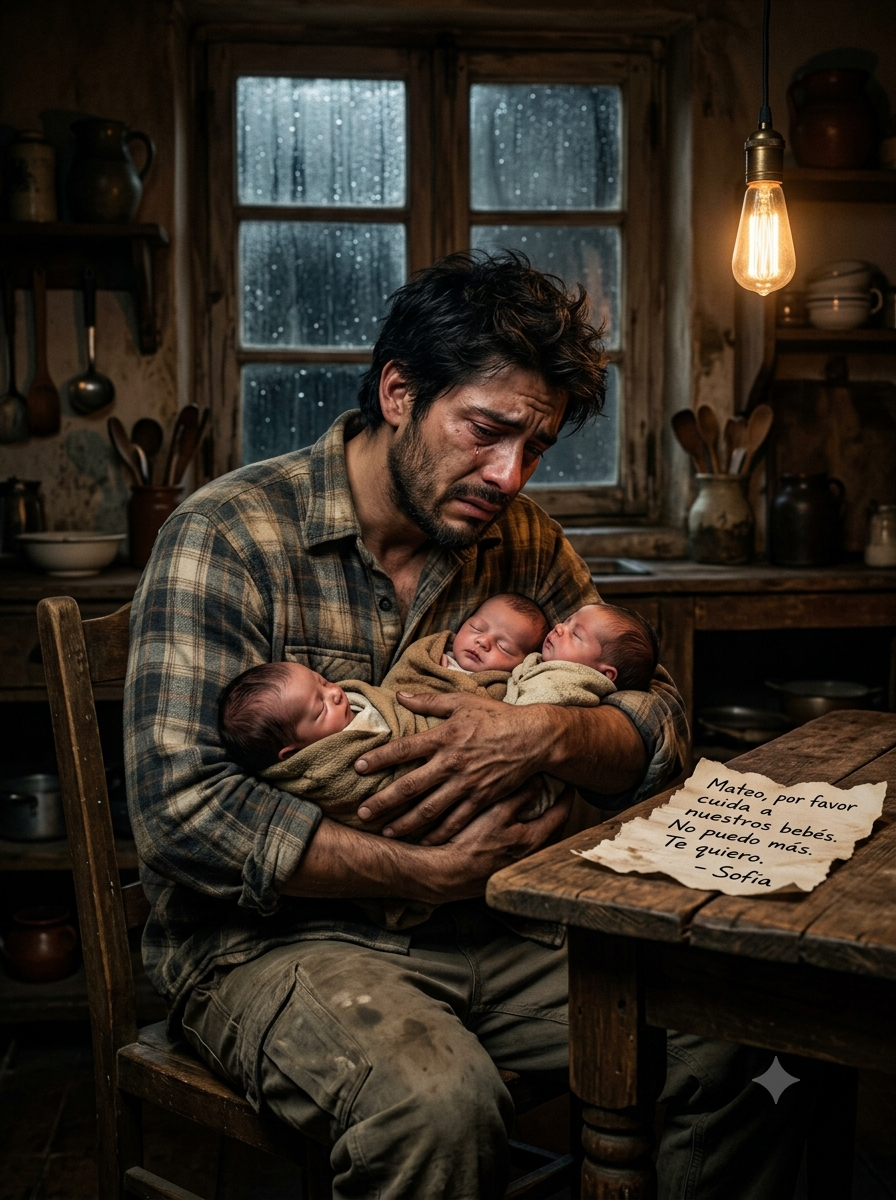
“Let’s begin with facts,” she said. “You left on April 18, thirty years ago. You left a note.”
Something flickered across Marisol’s face.
Ava continued. “The note said: ‘Rafael, I can’t live this way anymore. The girls are yours now. Don’t look for me. Marisol.’”
Rafael briefly closed his eyes.
He could still picture the paper. Blue lines. Torn from a grocery-pad sheet. The handwriting hurried, slanted, almost angry. He had read it while one baby cried in the bedroom and another slept against his chest. He read it again at noon, again at sunset, again after midnight, as though different light might somehow change the words.
Marisol whispered, “You kept it.”
“I did,” Rafael said.
“Why?”
“So I would never lie to them.”
That answer struck harder than any accusation.
Ava said, “We were three months old. You made no contact during our childhood. No birthday cards, no calls, no legal support, no medical history. Is any of that untrue?”
Marisol tightened her grip on her purse.
“No.”
“Did Rafael prevent you from contacting us?”
“No.”
“Did he threaten you?”
“No.”
“Did he ever ask you for money?”
“No.”
Ava nodded once. “Then your claim is not legal. It is emotional. So speak emotionally.”
Marisol looked genuinely surprised.
Carmen leaned back in her chair. “That’s fair, Ava. Painfully fair.”
Sophie watched her mother with an expression impossible to read.
Marisol drew a measured breath. Outside, a helicopter crossed the gray sky before disappearing into the mist.
“I was twenty-five,” she said. “I had three babies who cried all night. Your father worked until his hands cracked. We owed money. I was tired in a way that made me feel hollow. I would look at myself in the mirror and not recognize my own face.”
Rafael stared at the table.
He remembered.
That was the cruelest part. He remembered her exhaustion. He remembered how she sometimes stood in the nursery doorway without entering, listening to the babies as if their cries came from somewhere impossibly distant. He had convinced himself it was temporary. That love could outlast fatigue.
Marisol continued. “A woman came through town. Her name was Celeste. She owned a boutique in Miami. She said I had beauty, presence, potential. She said I was wasting my life.”
Carmen let out a small sound of disbelief.
Marisol looked at her. “It sounds foolish now. But when you are drowning, even a stranger’s hand looks like rescue.”
“Did she rescue you?” Sophie asked.
The light faded from Marisol’s eyes.
“For a while, she used me. I worked in her shop. Modeled clothes for clients. Went to parties where wealthy men treated women like decorations. I told myself it was better because the lights were bright and nobody knew my past.”
“And then?” Ava asked.
“I married one of those men.”
Rafael’s grip tightened around his cane.
Marisol noticed.
“His name was Victor Alarcon,” she said. “He was older. Charming. Generous when people were watching. He liked that I had no family asking questions.”
Something shifted subtly in Carmen’s expression. She knew men like that. Navarro Global had declined partnerships with several of them.
“I won’t give details,” Marisol said. “Not because I want pity, but because they belong to another life. The marriage ended. There was money for a time, then lawsuits, then nothing. I invested badly. Trusted badly. A year ago, I was diagnosed with a heart condition.”
Sophie straightened in her chair.
Rafael turned fully toward her.
Marisol raised a hand. “I am not dying tomorrow. But I was told to put my affairs in order.”
“So you came for money,” Carmen said.
“I came because I realized I had nothing real.”
The words settled over the room in quiet stillness.
Not an excuse. Not enough. But real.
Ava studied her. “Why one billion dollars?”
Marisol looked down at her purse.
When she answered, her voice was quieter.
“Because that was the number my attorney suggested would force you to respond.”
Daniel Cho’s mouth flattened.
“Your attorney gave poor advice,” he said.
Marisol almost smiled. “He was not a good attorney.”
Carmen rubbed her forehead. “This is unbelievable.”
“No,” Sophie said softly. “It’s believable. That’s what makes it worse.”
Rafael looked at Sophie.
She was staring at Marisol with something he had not expected. Not forgiveness. Not welcome. Recognition, perhaps. Sophie had always been able to sense when a person was cornered, even when they hid it well. It made her fierce in business and unexpectedly tender with frightened children and old dogs.
Ava leaned back.
“So the billion-dollar demand was a door.”
“A terrible one,” Marisol said.
“The worst door,” Carmen muttered.
“But a door,” Ava finished.
Marisol nodded.
Rafael exhaled slowly.
“Why didn’t you just write the truth?” he asked.
Her face folded slightly. For the first time, age showed plainly.
“Because I did not think you would open that letter.”
“I might have.”
“No,” she said. “You would have read it. You would have been kind. That is different.”
Rafael had no answer.
Kindness, he had learned, did not erase consequences. Sometimes kindness simply made room for consequences to stand without cruelty.
Ava turned to Daniel. “Leave us for a few minutes.”
Daniel hesitated. “Ava—”
“It’s all right.”
Elena opened the door. Daniel stepped out reluctantly. Elena followed, closing the door behind them.
Now it was only family.
Or the question of family.
The rain softened against the windows.
Carmen was the first to speak after the door shut.
“When I was sixteen,” she said, “I won the state entrepreneurship competition. Do you know what my idea was?”
Marisol shook her head.
“A bookkeeping app for small contractors. I built it because Dad kept losing invoices in a shoebox.”
Despite everything, Rafael smiled.
“It was a very organized shoebox,” he said.
“It was chaos,” Carmen replied, but gently. She looked back at Marisol. “I stood on a stage with a cardboard poster and a borrowed blazer. Every other finalist had parents taking pictures. Dad was there with sawdust still in his hair because he’d come straight from a job. He kept clapping before I even finished speaking.”
Marisol’s eyes lowered.
“I used to imagine you in the audience,” Carmen said. “Not because I missed you. I didn’t know you enough to miss you. But because I wanted you to see what you walked away from.”
Her voice broke on the last word, and she stopped.
Sophie reached for her hand under the table.
Ava spoke next.
“At ten, I had pneumonia. Dad slept in a chair beside my hospital bed for four nights. He sang the same song over and over because it was the only one he knew all the words to.”
Rafael chuckled softly. “I still don’t know if they were the right words.”
“They weren’t,” Ava said, and for a moment the sisters smiled.
Then she looked at Marisol.
“The nurse asked for family medical history. Dad couldn’t answer. He looked ashamed, as if he had failed me. He had not failed me. You had left him without answers.”
Marisol pressed a hand to her mouth.
Sophie’s voice came last.
“When I was twenty-one, I found your old note.”
Rafael turned. “Sophie.”
She looked at him apologetically. “I’m sorry, Dad. I was looking for tax documents in the cedar chest.”
He nodded, though the memory pained him.
“I read it,” Sophie said to Marisol. “And for a week I hated you more clearly than I had ever hated anyone. Then I hated myself for caring. Then I hated Dad a little because he had kept it.”
Rafael’s eyes filled.
Sophie squeezed his arm.
“But then I realized he kept it because he refused to make you into a monster for us. He could have. It would have been easy. Instead, whenever we asked, he said, ‘Your mother made a choice I don’t understand.’ That was all.”
Marisol closed her eyes.
“He gave you more mercy than you gave him,” Sophie said.
“I know,” Marisol whispered.
The room quieted.
For years, the sisters had carried their mother like a blank space. Now she sat before them, not grand enough to explain the wound, not wicked enough to make hatred simple. Just human. Flawed, proud, frightened, and far too late.
Ava stood and walked to the window.
Far below, traffic moved like beads of light through the wet streets.
“We are not giving you one billion dollars,” she said.
Marisol nodded. “I know.”
Carmen blinked. “You know?”
“I knew the moment I saw his face.” Marisol looked at Rafael. “I thought I came prepared. I thought I could stand tall and make demands. Then I saw you sitting in that chair, and I remembered the old kitchen.”
Rafael’s voice softened. “Which part?”
“The leak above the stove.”
He gave a small laugh. “I fixed that.”
“You fixed everything.”
“No,” he said. “I didn’t.”
The honesty landed gently.
Ava turned from the window. “We will pay for independent medical evaluation and treatment. Not as a settlement. Not as hush money. As a decision we make for ourselves.”
Carmen looked surprised, but did not object.
Sophie nodded slowly.
Marisol stared at Ava. “Why?”
“Because we don’t want your illness to become another unanswered question,” Ava said. “Because medical history matters. Because whether we like it or not, your health may tell us something about ours.”
“And because Dad taught us not to confuse boundaries with hardness,” Sophie added.
Carmen sighed. “And because apparently my sisters are determined to keep me from becoming the family villain.”
A faint smile touched Rafael’s mouth.
Marisol’s eyes filled, but she did not let the tears fall.
“I don’t deserve that,” she said.
“No,” Ava replied. “You don’t. But deserving is not the only measure we use.”
That was Rafael’s lesson too, though he had never said it so elegantly. He had taught it by giving neighbors extra bread when they could not pay. By repairing a widow’s porch for half price and pretending the wood had been discounted. By telling three daughters that dignity was not something poverty could take unless you handed it over.
Marisol opened her purse with trembling fingers.
“I brought documents,” she said.
Carmen straightened. “What documents?”
“Medical records. Marriage records. Financial papers. Things your legal team asked for. And…” She hesitated. “Some things I was not sure I would show you.”
Ava returned to the table.
Marisol pulled out a worn envelope.
It did not match the rest of her. The edges were soft, the paper yellowed. Rafael recognized it immediately though he had not seen it in thirty years.
His old handwriting.
Marisol placed it on the table.
Rafael stared.
“What is that?” Sophie asked.
“A letter your father wrote me,” Marisol said.
Rafael’s brow furrowed. “I wrote you many letters. None came back.”
“I received three.”
The air changed.
Rafael’s eyes lifted sharply. “You received them?”
Marisol nodded, shame crossing her face. “Celeste brought them to me. She said you had found me somehow. She said if I answered, you would drag me back. I was afraid. Angry. Proud. I burned the first two.”
Carmen whispered, “Of course you did.”
Marisol touched the envelope. “I couldn’t burn this one.”
Rafael reached for it, then stopped.
“May I?” Ava asked.
He nodded.
Ava opened the envelope carefully. Inside was a folded letter, creased so many times the seams looked fragile. She unfolded it and read silently at first. Her expression shifted.
Then, in a voice quieter than her boardroom voice, she read aloud.
“Marisol,
I don’t know if this letter will find you. I hope it does. The girls are growing. Ava watches everything like she is keeping records for heaven. Carmen screams louder than the kettle when she wants milk. Sophie grabs my finger and won’t let go.
I am angry. I won’t lie. Some nights I say your name like a curse, and some mornings I miss you before I remember not to.
But I am writing because they deserve to know where they come from. Not someday from strangers. From us.
I will not force you back. I cannot promise I understand. I only ask that you write down what you can—your family illnesses, your mother’s name, anything that might matter when they ask questions I cannot answer.
If you want to see them, write first. If you don’t, send the information anyway.
They are beautiful. They are difficult. They are alive.
Rafael.”
Ava stopped reading.
No one spoke.
Rafael had forgotten those exact words, but he remembered the night he wrote them. He remembered a storm outside, three babies finally asleep, the table lamp flickering because the wiring was bad. He had written slowly, not trusting his anger. He had folded the letter and mailed it to an address a cousin had found through a friend of a friend in Miami.
He had never known it arrived.
Marisol wiped one tear with the heel of her hand.
“I kept it in every apartment,” she said. “Every marriage. Every move. I told myself I kept it because someday I’d answer. Then someday became impossible.”
“Someday is not a plan,” Carmen said, but the anger had drained from her voice.
“No,” Marisol said. “It’s where cowards hide.”
Rafael looked at her then.
It was the first fully honest thing she had said.
Ava folded the letter again with careful hands.
“Why show us now?” she asked.
“Because your father tried,” Marisol said. “You should know that. Whatever else happened, he tried to keep the door open.”
Sophie looked at Rafael. “Dad?”
He gave a small shrug, uncomfortable under their gaze.
“You were babies,” he said. “I thought… one day you might need her. Or she might need you.”
“And you never told us?”
“I didn’t want you waiting by a window for someone who might not come.”
The words broke something gentle in the room.
Carmen stood abruptly and walked to the window. Her shoulders shook once, but when she turned back, her face was composed.
“Here is what happens next,” she said. “We do not resolve thirty years in one conversation. We do not pretend this is a reunion. You will not come into our lives through headlines or demands. You will not use our names publicly. You will cooperate with legal verification and medical disclosure. You will speak to us only when we choose to speak.”
Marisol nodded.
“And you will apologize to him,” Carmen said.
Marisol looked at Rafael.
The apology did not come quickly. Perhaps that made it better. She seemed to search for words that were not polished, not rehearsed.
Finally, she said, “Rafael, I am sorry I left you with everything. I am sorry I made my fear into your burden. I am sorry I let you carry alone what we created together.”
Rafael’s eyes shone.
“I wanted to hate you forever,” he said. “It would have been easier.”
“I know.”
“But there were three little girls in the house. Hate takes up too much room.”
Marisol covered her face.
Sophie stood and went to him, resting her hand on his shoulder. Carmen returned to his other side. Ava remained still for a moment, then came around the table and kissed the top of his head.
Marisol watched them.
Not with envy. Not exactly.
With the expression of someone seeing the life she had missed, not as an accusation, but as a country she could never enter by right.
A knock came at the door.
Daniel stepped in, holding a tablet. His expression was controlled, but Ava knew him well enough to see concern.
“I’m sorry to interrupt,” he said. “There is something you need to see.”
Ava straightened. “What is it?”
“Elena’s team found the source of the leak to the press. The reporters didn’t come prepared for Marisol by coincidence. Someone sent them a tip this morning.”
Carmen turned toward Marisol.
Marisol looked genuinely confused. “I didn’t contact reporters.”
Daniel’s gaze moved to her. “We don’t think you did.”
He placed the tablet on the table.
On the screen was a forwarded email. The subject line read:
THE NAVARRO SISTERS’ REAL MOTHER RETURNS TODAY.
Below it was a brief message with details of the event, Marisol’s name, and the billion-dollar demand.
Ava read the sender address twice.
“That can’t be right,” she said.
Sophie leaned closer. “Who is it?”
Daniel hesitated.
“The email was sent from an account linked to the estate of Victor Alarcon,” he said. “Marisol’s former husband.”
Marisol’s face went pale.
“That’s impossible,” she whispered.
“Why?” Carmen asked.
Marisol’s hand trembled as she reached for the back of a chair.
“Because Victor has been dead for six years.”
A silence fell so complete that even the rain seemed to pause.
Then Daniel swiped the screen.
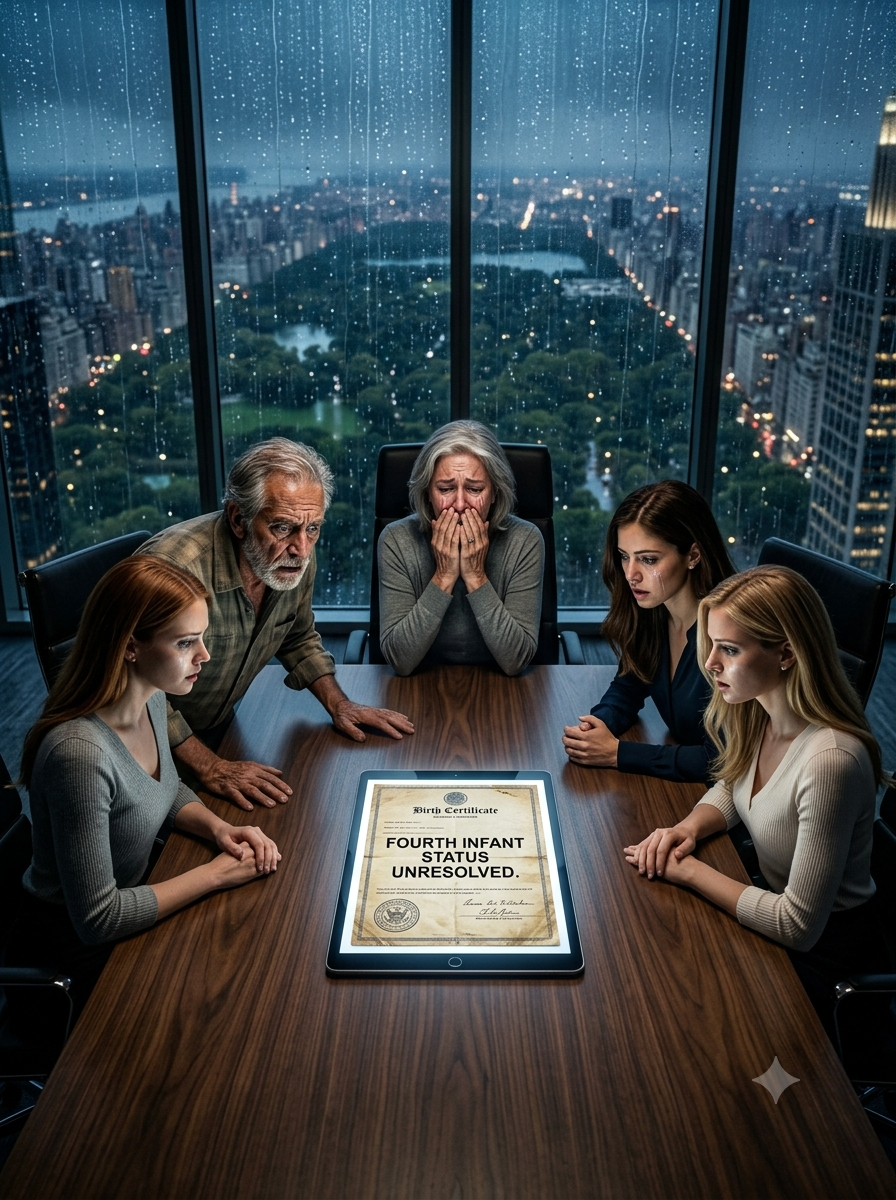
“There’s more,” he said. “Attached to the email was a scanned document. It appears to be an old birth certificate amendment request. I have not verified it yet.”
Ava looked down.
Three names were visible.
Ava Navarro.
Carmen Navarro.
Sophie Navarro.
And beneath them, in a field marked “additional notation,” were words that made Rafael’s breath catch.
Marisol whispered, “No…”
Sophie read the line aloud, barely above a breath.
“Twin pregnancy recorded prior to live triplet birth. Fourth infant status unresolved.”
Carmen stared at the screen. “Fourth infant?”
Ava’s face drained of color.
Rafael slowly rose from his chair.
“I was told there were three,” he said.
Marisol looked at him, tears spilling freely now, her voice shaking with terror and memory.
“So was I.”
PART 3 — FINAL PART
The words seemed to remain in the air long after Sophie had spoken them.
Fourth infant status unresolved.
No one moved.
Beyond the conference room windows, Manhattan continued as if nothing had changed. Cars slid along rain-dark streets. Office lights flickered awake across the skyline. Somewhere below, guests were still whispering about the woman who had walked into Navarro Global and demanded one billion dollars from the daughters she had abandoned.
But on the fifty-third floor, a family had been pulled into a mystery older than the empire they had built.
Rafael stood slowly, one hand gripping the back of his chair.
“I was told there were three,” he repeated, but this time the words sounded less like a statement and more like a plea.
Marisol pressed both hands to her mouth. Her polished composure had vanished entirely. She looked smaller now, almost fragile inside her cream suit, as if the years had rushed back to claim her all at once.
Ava stared at the tablet.
Carmen leaned over the screen, reading the line again and again as if repetition might change it.
Sophie looked from Marisol to Rafael. “How could this happen?”
No one answered.
Daniel Cho, usually calm enough to steady entire boardrooms, cleared his throat. “This document is not verified. It may be altered. It may be incomplete. We need records before we assume anything.”
“Where did it come from?” Ava asked.
“The email account appears connected to Victor Alarcon’s estate records,” Daniel said. “But that does not mean Victor sent it. Someone may have access. Someone may be using his name.”
Marisol’s eyes sharpened with fear. “Victor knew.”
Rafael turned toward her. “Knew what?”
Marisol swallowed. “He knew I had daughters. I told him once, years after I left. Not everything. Just that I had children from my first marriage.”
Carmen’s voice was quiet. “Did you tell him there might have been four?”
“No.” Marisol shook her head quickly. “Because I didn’t know.”
Ava lifted the tablet and enlarged the document. “This says ‘twin pregnancy recorded prior to live triplet birth.’ That wording doesn’t even make sense.”
“It may refer to an early scan,” Daniel said. “Sometimes early records change as pregnancy develops. But ‘fourth infant status unresolved’ is unusual. Very unusual.”
Rafael sat back down as though his legs had weakened. Sophie moved beside him immediately, resting a hand between his shoulders.
“Dad,” she said softly, “look at me.”
He tried.
His eyes were wet, not with panic, but with something deeper—the grief of a man wondering whether he had failed a child he never knew existed.
“I brought three babies home,” he whispered. “Three car seats. Three blankets. Three names written on the hospital bands. Ava, Carmen, Sophie.”
Marisol sank into a chair. “I remember the delivery room only in pieces. There were lights. Voices. I was so tired. Someone said the babies were small but strong. Then I slept.”
“You never asked?” Carmen said.
Marisol flinched. “I asked about my babies. They brought me three.”
The anger that Carmen had carried since Marisol entered the building did not disappear, but it shifted. It had nowhere simple to land now. Not when her father looked broken. Not when her mother’s face carried the first honest terror Carmen had ever seen there.
Ava turned to Daniel. “Find the hospital records.”
“I’ll start immediately,” he said.
“And quietly,” Ava added. “No leaks. No assumptions. No press.”
Daniel nodded. “Understood.”
He left the room, but the question remained sitting at the table like an unexpected guest.
A fourth child.
A fourth Navarro.
A sibling whose life had disappeared into a line on a document.
For several minutes, no one spoke. The sisters had built a company by acting when others froze, but this was not a market crisis. This was blood, memory, and possibility. There was no spreadsheet for it.
Finally, Rafael looked at Marisol.
“What hospital?” he asked.
“Santa Teresa Medical Center,” she said. “The old maternity wing. It closed years ago.”
“I remember,” Rafael said. “The roof leaked in the waiting room.”
Marisol gave a faint, aching smile. “You complained to the nurse about it.”
“I was nervous.”
“You brought flowers from a gas station.”
“They were all I could afford.”
“They were beautiful,” she said.
For the first time since she had arrived, the room saw them not as a betrayed husband and a returning wife, but as two young people who had once stood together at the edge of becoming parents, frightened and hopeful, unaware of all that would follow.
Sophie sat down slowly. “We need to know.”
Ava nodded. “We will.”
Carmen folded her arms. “And if this is someone manipulating us?”
“Then we find that out too,” Ava said.
Marisol looked up. “I want to help.”
Carmen’s eyes hardened by instinct.
Marisol did not look away. “Not to earn anything. Not to rewrite anything. If there was another baby, I need to know too.”
Rafael studied her. Then he nodded once.
“All right,” he said. “We start with the truth.”
And for the first time in thirty years, the people in that room agreed on something.
They would search together.
That night, the celebration ended quietly.
Navarro Global released a brief statement saying a private family matter had interrupted the opening ceremony and asking for respect. The statement did not mention Marisol’s demand, the billion dollars, the old letter, or the mystery document. By morning, the internet had already made guesses, but guesses could not touch what the family was carrying.
Rafael stayed in Ava’s guest suite instead of returning to his small house upstate. The sisters insisted. Marisol checked into a modest hotel nearby after refusing their offer of a company apartment.
“I need to stand on my own feet somewhere,” she told Sophie in the lobby.
Sophie did not embrace her. Not yet. But she arranged for a physician to review Marisol’s medical file the next morning.
That was how healing began in the Navarro family—not with grand speeches, but with practical kindness.
At dawn, Ava found Rafael in the kitchen, making coffee in a machine so expensive it looked like it belonged in a laboratory.
“You hate that thing,” she said.
“It hisses at me,” Rafael replied. “Like it knows I don’t belong here.”
Ava smiled and took a mug from the cabinet. “You belong everywhere we are.”
He looked at her.
The smile faded from her face because she saw the question still haunting him.
“You’re thinking about the fourth baby.”
“I’m trying not to,” he said.
“Dad.”
He leaned against the counter. “When you were born, everything was chaos. Nurses going in and out. Your mother pale as paper. Three tiny babies. I was terrified to touch you because my hands were rough. I kept counting. One. Two. Three. I counted again and again.”
Ava held the warm mug between her palms.
“What if I should have counted to four?” he asked.
She set the mug down and crossed the kitchen. Then she wrapped her arms around him.
Rafael held himself stiffly for one breath, then folded into the embrace. Ava had always been his careful child, the one who solved problems before admitting she felt them. But now she rested her cheek against his shoulder like the little girl who once climbed into his lap with multiplication flashcards.
“You didn’t lose anyone,” she whispered. “You were given what they handed you. You loved who came home.”
Rafael closed his eyes.
“Still,” he said, “what if someone needed me?”
Ava did not answer quickly.
Then she said, “Then we find them.”
By noon, Daniel had assembled a small team: a retired records investigator, a medical archivist, and a family law attorney who specialized in sealed adoption and birth records. They met not at Navarro headquarters but in Rafael’s suite, at his request.
“I don’t want this to feel like business,” he said.
The investigator, a silver-haired woman named Miriam Bell, placed a folder on the coffee table.
“Santa Teresa Medical Center closed in 2004,” Miriam said. “Some paper records transferred to the county archive. Some were digitized. Some were damaged in a basement flood before transfer.”
Carmen groaned softly. “Of course.”
Miriam continued. “However, maternity records were partially preserved because of state reporting requirements. We found the birth registrations for Ava, Carmen, and Sophie Navarro.”
“And?” Sophie asked.
Miriam’s expression was careful. “Three live births officially registered.”
Rafael exhaled, but relief did not come.
Ava noticed Miriam had not finished.
“There is also a neonatal transfer log from that night,” Miriam said.
Marisol gripped the edge of her chair.
Miriam opened the folder. “A premature female infant was transferred from Santa Teresa to St. Agnes Children’s Hospital at 2:14 a.m. The mother’s name is partially smudged, but the first name appears to be Marisol. The surname is unreadable.”
The room went still.
Carmen leaned forward. “Female infant?”
“Yes.”
“Was she ours?” Ava asked.
“We cannot say yet.”
Rafael’s voice came rough. “What happened to her?”
Miriam looked down at the page. “The log says respiratory distress. Emergency transfer. No parental signature visible.”
Marisol stood suddenly and walked to the window, one hand over her heart.
“No one told me,” she whispered.
Rafael looked at her, and for once there was no old anger in his face. Only shared horror.
Miriam said, “There may be an explanation. Emergency transfers sometimes moved quickly. Parents could have been informed later. Records may be missing. But there’s something else.”
Carmen’s eyes narrowed. “There always is.”
“The attending obstetrician was Dr. Helena Voss.”
Rafael frowned. “I remember a Dr. Voss.”
Marisol turned. “So do I.”
Miriam closed the folder. “She is still alive. Eighty-two years old. Lives in Vermont.”
Ava stood. “Then we go to Vermont.”
Daniel began to speak about scheduling, discretion, legal preparation, but Carmen cut him off.
“No helicopters. No motorcade. No dramatic billionaire arrival.”
Rafael looked at his daughters, then at Marisol.
Marisol lowered her eyes. “I understand if you don’t want me there.”
Ava studied her for a long moment.
“You were in that delivery room,” she said. “So were Dad and Dr. Voss. If we want the truth, all three living witnesses should be present.”
Carmen did not object.
That, for Marisol, was almost a gift.
The next morning, they drove north in two ordinary black SUVs through rain-washed highways and hills that grew greener with every mile. Rafael sat in the front passenger seat of the first vehicle, watching the city loosen its grip on the landscape. Ava drove because she said thinking was easier with her hands on a wheel. Carmen and Sophie sat behind them, their laptops closed for once.
Marisol rode in the second car with Daniel and Miriam.
“She’s alone back there,” Sophie said after an hour.
Carmen looked out the window. “She’s been alone by choice for a long time.”
“Maybe,” Sophie said. “Maybe not always.”
Carmen glanced at her. “You’re already softening.”
Sophie smiled faintly. “You say that like it’s a crime.”
“It’s a risk.”
“So is staying hard forever.”
Carmen had no answer to that.
Ava glanced at them through the mirror. “We’re not deciding what she is to us today. We’re finding out what happened.”
Rafael nodded. “One truth at a time.”
They found Dr. Helena Voss in a white farmhouse at the end of a road lined with maple trees. The rain had stopped, leaving the air clean and bright. Wind moved through the leaves like whispered conversation.
Dr. Voss answered the door herself.
She was small, straight-backed, and sharp-eyed behind round glasses. Her silver hair was braided over one shoulder. She looked at the visitors on her porch with the expression of a woman who had spent her life delivering difficult news and knew when more had arrived.
“Marisol,” she said.
Marisol inhaled sharply. “You remember me?”
Dr. Voss looked past her to Rafael. “And Rafael.”
Rafael’s hand tightened around his cane.
Then the doctor’s gaze moved to the sisters. One by one.
“Ava,” she said softly. “Carmen. Sophie.”
Carmen’s eyebrows lifted. “You remember us too?”
“I remember every child from that night,” Dr. Voss said.
The porch seemed to tilt beneath them.
Ava’s voice was steady only because she forced it to be. “Every child?”
Dr. Voss stepped aside. “Come in.”
Her sitting room smelled of lemon tea, old books, and woodsmoke. Family photographs lined the mantel, but none of the faces were familiar. A quilt lay folded over the arm of a chair. On the coffee table sat a stack of medical journals, a pair of reading glasses, and a small ceramic bowl filled with wrapped candies.
Dr. Voss lowered herself into an armchair.
“I wondered when this would come,” she said.
Rafael remained standing. “When what would come?”
“The question you should have been allowed to ask thirty years ago.”
Marisol sat heavily.
Dr. Voss folded her hands. “There were four infants.”
Sophie covered her mouth.
Carmen whispered, “Oh my God.”
Ava did not move.
Rafael’s face went gray.
Dr. Voss spoke gently but clearly. “The fourth was a girl. The smallest. She was delivered last. She struggled to breathe. Santa Teresa was not equipped for her needs. I ordered an immediate transfer to St. Agnes.”
“Why weren’t we told?” Rafael asked.
Dr. Voss’s eyes filled with an old sorrow. “You were told there was a complication. You were not told enough.”
“That’s not an answer,” Carmen said, her voice tight.
“No,” Dr. Voss said. “It is not.”
Marisol leaned forward. “What happened to my baby?”
The doctor looked at her. “She survived.”
The room seemed to exhale and break at once.
Rafael sat down slowly, his cane slipping from his hand to the rug.
“She lived?” he whispered.
“Yes.”
“Where is she?” Ava asked.
Dr. Voss closed her eyes for a moment.
“Her name was recorded at St. Agnes as Elena.”
“Elena,” Sophie repeated.
“Elena Navarro?” Carmen asked.
“No,” Dr. Voss said. “Elena Grace.”
Ava’s brow furrowed. “Why Grace?”
“Because she was admitted without confirmed parental custody paperwork. A hospital social worker used a temporary surname until records could be reconciled.”
Rafael stared at her. “But they were never reconciled.”
“No.”
“Why?”
Dr. Voss’s voice trembled for the first time. “Because I made a mistake by trusting the wrong person.”
Miriam leaned forward. “Who?”
Dr. Voss looked at Marisol. “Celeste.”
Marisol went utterly still.
The name struck the room like a door opening into the past.
“Celeste?” Rafael asked.
“The woman who took me to Miami?” Marisol said.
Dr. Voss nodded. “She came to the hospital two days after the birth. She said she was your cousin. She had information about where you could be reached. She said Marisol was overwhelmed and that Rafael had agreed the fourth baby should be placed temporarily in medical foster care until the family stabilized.”
Rafael rose to his feet. “I agreed to no such thing.”
“I know that now,” Dr. Voss said.
Marisol’s voice cracked. “Celeste lied.”
“Yes.”
Dr. Voss’s eyes filled. “I was younger then. Overworked. The hospital was understaffed. The social worker handling the case left suddenly. Forms were signed. Not by you, Rafael. Not by Marisol. But by someone claiming family authority.”
Daniel, who had remained quiet, asked, “Do you have copies?”
Dr. Voss nodded toward a cabinet near the wall. “I kept them.”
Carmen stared. “You kept illegal paperwork for thirty years?”
“I kept evidence of a wrong I did not know how to correct without harming a child whose adoption had already begun,” Dr. Voss said quietly. “That is not an excuse. It is the truth.”
Rafael’s voice shook. “Adoption?”
“Elena was placed with a couple in New Jersey when she was nine months old. A good couple. Samuel and Ruth Bennett. They had lost two pregnancies. They loved her deeply.”
Sophie’s eyes filled with tears. “Is she alive?”
Dr. Voss smiled through her sadness.
“Yes.”
Ava felt the world narrow to one point. “Do you know where she is?”
Dr. Voss looked at the sisters, then at Rafael, then finally at Marisol.
“Yes,” she said. “But before I tell you, there is something you must understand. Elena was not stolen by the Bennetts. They believed everything was legal. They raised her with love. She is not a missing possession. She is a person with a life, a history, and parents who held her when you could not.”
The words landed heavily, but they were necessary.
Rafael nodded first.
“Of course,” he said. “Of course.”
Marisol wept silently.
Carmen looked away, wiping her eyes with quick, impatient fingers.
Ava’s voice was barely audible. “What is her full name now?”
Dr. Voss stood and retrieved a sealed envelope from the cabinet. Her hands shook as she held it out.
“Elena Bennett Ward.”
For a moment, no one understood.
Then Sophie turned sharply toward Daniel.
“Elena Ward?” she said. “Our Elena?”
The company’s head of communications.
The woman who had guided guests away from the atrium. The woman who had stood by the door of the conference room while their family history cracked open. The woman who had worked beside them for five years, calm, loyal, discreet, brilliant.
Carmen’s mouth fell open. “No. That’s impossible.”
Ava took the envelope but did not open it.
“Elena Ward works for us,” she said.
Dr. Voss nodded. “I know. She came to see me three months ago.”
Rafael gripped the arm of the chair. “She knows?”
“She suspected,” Dr. Voss said. “She was adopted. After Ruth Bennett died, Elena found a box of papers. Hospital bracelets. A temporary birth record. A name—Marisol. And three infant girls listed on a damaged form.”
Ava’s mind raced back through the years.
Elena joining Navarro Global after leaving a prestigious media firm.
Elena’s unusual loyalty.
Elena’s quiet attention whenever Rafael visited the office.
Elena remembering his coffee preference after one meeting.
Elena once pausing in the doorway when Sophie joked, “Triplet instinct. You wouldn’t understand.”
Ava sat down hard.
“She has been near us all this time.”
Dr. Voss nodded.
“Did she send the email?” Carmen asked.
“No,” said a voice from the doorway.
They turned.
Elena Ward stood in the entrance of the sitting room, raincoat folded over one arm, her face pale but calm.
No one spoke.
She looked first at Dr. Voss. “I’m sorry. The door was open.”
Then she looked at Rafael.
Her voice softened.
“Hello, Mr. Navarro.”
Rafael stood as if pulled by a thread.
“Elena,” he whispered.
She tried to smile, but emotion broke it. “I didn’t know how to tell you.”
Sophie took one step toward her, then stopped, uncertain whether to embrace a colleague, a stranger, or a sister.
Carmen’s eyes were wet and guarded. “How long have you known?”
“Known? I still don’t know.” Elena’s gaze moved across the three sisters. “Suspected? Three months.”
Ava held the envelope. “Why didn’t you come to us?”
Elena’s fingers tightened around her coat. “Because I watched you love your father. I watched what your family meant to people. I thought if I was wrong, I would look like a woman inventing a connection to powerful people. And if I was right…”
“If you were right?” Sophie asked.
Elena looked at Rafael.
“Then I had to accept that another father existed before the one who raised me. And I loved my parents. I still do.”
The room softened.
Rafael understood. Better than anyone, perhaps.
“Love doesn’t cancel love,” he said.
Elena’s eyes filled.
“I wanted to tell you yesterday,” she said. “But then Marisol arrived, and the email leaked everything sideways. I panicked. I stayed in my role because it was the only thing I knew how to do.”
Carmen let out a shaky laugh. “You handled a family crisis while secretly being the family crisis?”
Elena almost laughed too. “That sounds accurate.”
Ava looked at Daniel. “Then who sent the email?”
Daniel checked his phone. “My team traced the estate account access. It was opened from a law office in Miami. One connected to Celeste Moreno.”
Marisol gripped the back of the sofa.
“She’s alive?” she whispered.
Daniel nodded. “And she appears to have been monitoring Marisol’s legal claim.”
Dr. Voss’s mouth tightened. “Celeste always knew where to profit from confusion.”
Marisol sat slowly. “She took my life apart twice.”
“No,” Rafael said quietly.
Marisol looked at him.
“She made choices,” he said. “So did you. So did I. We follow the truth, but we don’t hand her every piece of blame just because it is easier.”
Marisol absorbed that with visible pain. Then she nodded.
“You’re right.”
Those two words seemed to cost her something. And because they did, they mattered.
The legal path unfolded over the next several weeks, not with dramatic arrests or public spectacles, but with careful documents, sworn statements, and patient truth.
Celeste Moreno, now in her seventies, had built a comfortable life arranging “private family solutions” for wealthy clients—some legal, some hidden under layers of influence and old favors. She had not sold Elena, not in the crude way tabloids later tried to imply when the truth emerged in court filings. The reality was quieter and more painful: she had manipulated a frightened young mother, an overwhelmed father, a chaotic hospital, and a childless couple desperate to love a baby.
She had forged authority where none existed.
She had told the Bennetts that the birth parents had surrendered the infant.
She had told Marisol nothing.
She had told Rafael nothing at all.
And years later, when she learned Marisol was seeking money from the Navarro daughters, Celeste saw danger. If Marisol entered the family’s life, old records might surface. So Celeste leaked enough information to create confusion, hoping the family would turn on one another before anyone looked too closely at her.
But she had misjudged the Navarros.
They did not turn away from hard truth.
They gathered around it.
Elena agreed to a private DNA test first with Ava, then Carmen and Sophie, then Rafael. The results came on a clear morning in early autumn.
Rafael refused to open the envelope without everyone present.
They met in his old house upstate, the same small home where the triplets had grown up. The house had been renovated over the years but not transformed into something unrecognizable. The kitchen still held a wooden table Rafael had built from salvaged oak. The backyard still had the crooked apple tree Sophie had once fallen from. In the living room, framed photos crowded the walls: first days of school, science fairs, graduations, company milestones, Rafael in a tuxedo looking deeply uncomfortable.
Elena stood near the mantel, studying a photograph of the sisters at age six, wearing matching yellow raincoats.
“I had a coat like that,” she said softly.
Sophie looked at her. “Really?”
“My mother bought it from a thrift shop. I refused to take it off for a week.”
Carmen smiled faintly. “Navarro stubbornness.”
Elena looked at her, uncertain.
Carmen’s smile warmed. “Apparently genetic.”
Ava entered with the envelope. Rafael sat at the table. Marisol stood near the back door, not intruding, not hiding. She had changed in the weeks since Vermont. Not completely. Not magically. But visibly. She dressed more simply now. She attended medical appointments. She answered questions from the sisters even when the answers made her look weak. She had stopped asking for anything.
That, more than apologies, had allowed the first thread of trust to form.
Ava placed the envelope on the table.
“No speeches,” Carmen said. “Open it before I climb out of my skin.”
Rafael opened it.
His hands shook.
Ava read over his shoulder.
Then she covered her mouth.
Sophie whispered, “Say it.”
Rafael looked at Elena.
His face crumpled into wonder.
“You are my daughter,” he said.
Elena closed her eyes.
No one rushed her. No one demanded tears. No one tried to force the moment into a shape.
Then Rafael stood, slowly, and opened his arms.
Elena crossed the room like someone walking through a dream. When she reached him, she stopped inches away.
“I had a father,” she whispered.
“I know,” Rafael said. “And I thank him.”
That was when she broke.
She stepped into his arms and wept, not like a child, but like a woman who had held herself together for too long. Rafael held her gently, one hand at the back of her head, the other between her shoulders.
The sisters watched through tears.
Marisol turned toward the window, pressing a hand to her mouth. Sophie went to her, hesitated, then placed a hand on her arm.
Marisol looked at the hand as if it were a miracle she did not deserve.
“Don’t make too much of it,” Sophie said, wiping her own eyes. “I’m just making sure you don’t faint.”
Marisol gave a broken little laugh.
Across the room, Elena pulled back from Rafael.
“I don’t know what to call you,” she admitted.
Rafael smiled through tears. “You don’t have to decide today.”
She nodded.
Then Carmen stepped forward, awkward for perhaps the first time in her adult life.
“So,” Carmen said, clearing her throat, “this is usually the part where I say something confident and memorable, but I have nothing.”
Elena laughed softly.
Carmen held out her hand, then seemed to realize how ridiculous that was and opened both arms instead.
Elena embraced her.
Sophie joined immediately, unable to wait. Ava lasted three seconds longer before wrapping them all in her arms.
Four sisters stood together in Rafael’s living room, uneven in history but unmistakable in presence. Ava’s steadiness. Carmen’s fire. Sophie’s courage. Elena’s quiet grace.
Rafael looked at them and saw not what had been stolen, but what had somehow returned.
Not unchanged.
Not unscarred.
But alive.
The public learned only what the family chose to share.
Navarro Global announced the establishment of the Santa Teresa Family Records Initiative, a foundation dedicated to helping adults access sealed or damaged birth, adoption, and medical records through ethical legal support. The announcement said the initiative was inspired by “a private family discovery that revealed the importance of truth, dignity, and compassionate record-keeping.”
Reporters pushed for more.
The sisters gave them little.
Ava said, “Some stories are not secrets. They are simply sacred.”
That sentence appeared in newspapers across the country.
Celeste Moreno faced legal consequences through proper channels. The process was slow, imperfect, and frustrating at times, but the family refused to turn it into a spectacle. Elena testified privately. Dr. Voss provided records and took responsibility for her part. Marisol gave a sworn statement that was painful, detailed, and honest.
Afterward, outside the courthouse, Carmen found Marisol sitting alone on a bench beneath a row of plane trees.
“You did well in there,” Carmen said.
Marisol looked up, surprised. “Did I?”
“You didn’t protect yourself at everyone else’s expense. That’s new.”
Marisol accepted the truth of it with a small nod.
Carmen sat beside her.
For a while, they watched people pass along the courthouse steps.
“I used to think forgiveness meant saying what happened was fine,” Carmen said.
“It wasn’t.”
“No,” Carmen agreed. “It wasn’t. But I’m starting to think maybe forgiveness is deciding the past doesn’t get to spend the rest of our lives in charge.”
Marisol’s eyes filled.
“I would like to know you,” she said carefully. “Only as much as you allow.”
Carmen looked ahead.
“I’m difficult,” she said.
Marisol smiled faintly. “I remember.”
Carmen turned to her. “No, you don’t. You left before I became interesting.”
Marisol laughed, startled and tearful.
Carmen stood, but before she walked away, she said, “Coffee next week. One hour. Don’t bring lawyers. Don’t bring speeches.”
Marisol nodded quickly.
“One hour,” she said.
It was not a reunion.
It was a beginning.
Elena’s beginning with the family was different.
She did not move into their lives all at once. She kept her apartment. Kept her surname. Kept photographs of Samuel and Ruth Bennett on her desk. On the first anniversary of Ruth’s passing, Rafael accompanied Elena to the cemetery in New Jersey.
The day was cold and bright. Elena placed white lilies at her parents’ grave.
Rafael stood a respectful distance away until she reached for his hand.
“My father taught high school history,” she said. “He used to say every person is more than one chapter.”
Rafael squeezed her hand gently. “Sounds like a wise man.”
“He would have liked you.”
“I hope so.”
“He would have been intimidated by the triplets,” Elena added.
Rafael smiled. “Most people are.”
Elena laughed softly, and the sound eased something in him.
Later, he left a small wooden bird he had carved beside the lilies. On the bottom, in careful script, he had written:
Thank you for loving our daughter.
Elena cried when she saw it.
That winter, the sisters gathered often at Rafael’s house.
At first, it was for practical reasons—medical histories, legal papers, foundation planning. Then the reasons became smaller and better. Dinner. Birthdays. A broken cabinet hinge Rafael insisted on fixing himself. Sophie’s new rescue dog, who adored Elena immediately and distrusted Carmen’s expensive shoes.
Marisol came sometimes too.
Not every time.
She was learning the discipline of not forcing doors open.
At one dinner, Rafael made arroz con pollo the way his mother had taught him. Ava corrected the seasoning. Carmen argued that the rice needed more pepper. Sophie stole chicken from the pan before it was served. Elena watched them with such open fascination that Carmen noticed.
“What?” Carmen asked.
Elena smiled. “I’m trying to figure out where I fit.”
Sophie pulled out the chair beside her. “Here. Obviously.”
Elena sat.
Marisol, from across the table, looked down at her plate. Rafael noticed.
After dinner, while the sisters washed dishes with more noise than efficiency, Marisol stepped onto the back porch. Snow lay over the yard, softening the old fence and the apple tree branches.
Rafael joined her.
For a while, they stood in silence.
“I lost so much,” Marisol said.
“Yes,” Rafael replied.
“I caused much of it.”
“Yes.”
She looked at him. “You don’t soften truth.”
“I spent too many years sanding wood. You learn what should be smoothed and what should remain solid.”
Marisol smiled faintly.
Inside, laughter rose from the kitchen. Four women’s voices, similar and different, weaving through steam and clattering plates.
“I don’t know whether they’ll ever love me,” Marisol said.
Rafael leaned on the porch railing. “Maybe don’t start there.”
“Where should I start?”
“By loving them without needing proof you’ll get something back.”
She absorbed that.
Then she whispered, “I am trying.”
“I know.”
Those two words, from Rafael, were not forgiveness in full. They were not forgetting. But they were recognition.
And for Marisol, they were enough to keep trying.
Spring arrived with rain and blossoms.
The Santa Teresa Family Records Initiative opened its first office in the same town where Rafael had once struggled to raise three daughters alone. The building was small, warm, and deliberately humble. No marble lobby. No intimidating glass walls. Just soft chairs, private rooms, patient counselors, and a wooden sign Rafael had made by hand.
On opening day, a line formed before sunrise.
Adults searching for birth parents.
Parents searching for children.
People seeking medical histories, adoption records, lost names, answers.
Ava stood inside the entrance, watching them through the window.
“We thought we were building a foundation,” she said.
Elena stood beside her. “Maybe we built a door.”
Carmen joined them, carrying a clipboard. “A well-funded, legally compliant door.”
Sophie laughed. “And there she is.”
Carmen pointed the clipboard at her. “Compassion without structure becomes chaos.”
“Structure without compassion becomes you before coffee.”
Elena laughed.
Ava turned at the sound.
For months, she had been waiting for the moment Elena’s laughter would stop sounding like a guest’s and start sounding like home. It happened quietly, without announcement, in a sunlit office where strangers had come hoping to be known.
Rafael gave the opening remarks.
He stood before the crowd in a navy suit his daughters had chosen and shoes he claimed pinched even though they did not. The sisters stood behind him. Marisol sat in the second row, not in the place of honor, not hidden either. Dr. Voss attended in a wheelchair, hands folded in her lap. She had insisted on coming.
Rafael looked out at the people gathered before him.
“I am a carpenter,” he began. “I know more about doors than speeches.”
Soft laughter moved through the room.
“A good door does two things. It protects what is inside, and it allows welcome when the time is right. For many families, records are doors. Sometimes they are locked for good reasons. Sometimes they are locked because someone made a mistake. Sometimes because someone was afraid. Sometimes because someone wanted power over a truth that belonged to someone else.”
He paused.
His daughters watched him with shining eyes.
“I raised three daughters for thirty years,” he continued. “Then I learned I had four. I cannot get back the years I missed with Elena. Her parents gave her a beautiful life, and I honor them. But I can be grateful for the years we have now.”
Elena bowed her head.
Rafael looked at the crowd.
“This place exists because people deserve truth with kindness. Not truth used as a weapon. Not truth sold to the highest bidder. Truth held carefully, like a child.”
He stepped back.
For a moment, no one clapped. Not because the words had failed, but because they had landed too deeply.
Then the applause rose.
Not thunderous. Not theatrical.
Human.
Warm.
Real.
After the ceremony, Dr. Voss asked to speak with Rafael alone. They sat in a small counseling room overlooking a garden.
“I have carried my part for thirty years,” she said.
Rafael nodded.
“I thought seeing this place might ease it,” she continued. “It does, a little. But not entirely.”
“Maybe it shouldn’t entirely.”
Dr. Voss looked at him.
He gave a small, sad smile. “Some regrets keep us careful.”
She breathed out shakily. “You are kinder than I deserve.”
“I’m not measuring what you deserve today,” Rafael said. “I’m looking at what you helped make right.”
Tears slipped down her cheeks.
Before she left, Dr. Voss handed him a small envelope.
“I found this in my files last week,” she said. “I had forgotten it existed. It belongs to you.”
Rafael opened it after she had gone.
Inside was a hospital photograph.
Four newborn girls lay side by side beneath a warming light, tiny and wrinkled, each wearing a little cap. Three had visible name bands. The fourth had only a temporary tag.
Rafael sat down.
His thumb hovered over the smallest face.
He had no memory of the photo being taken. No memory of seeing all four together. Yet there they were, proof that for one brief moment, before confusion and fear and human failure scattered them, his daughters had shared the same light.
Ava found him there.
“Dad?”
He handed her the photograph.
She looked at it and went still.
One by one, she called her sisters.
Carmen came first, then Sophie, then Elena. Marisol appeared in the doorway and stopped, unsure if she was permitted to enter. Elena saw her and held out a hand.
Marisol came in.
Together, they looked at the photograph.
Four tiny girls.
One beginning.
Many roads.
Carmen wiped her eyes and said, “I’m the one with the dramatic fist. Obviously.”
Sophie leaned closer. “No, that’s me.”
Ava pointed. “This one is watching everything. That’s me.”
Elena smiled through tears. “Then I’m the blurry one?”
Rafael shook his head.
“No,” he said. “You’re the one we hadn’t found yet.”
Elena looked at him, and the smile that came through her tears was full of both grief and belonging.
Months later, on Rafael’s seventieth birthday, the sisters planned a small dinner.
Small, in their world, meant sixty people, two tents in the yard, musicians from Rafael’s church, half the town, and enough food for a village. Rafael complained from morning until afternoon that it was too much, then spent the evening beaming at every guest.
Ava gave a toast about endurance.
Carmen told a story about Rafael trying to learn email and accidentally sending a grocery list to a venture capital firm.
Sophie presented him with a restored version of his old workbench, the one he had used through their childhood.
Elena gave him a framed copy of the hospital photograph.
Marisol stood at the edge of the gathering for a long time before Carmen nudged her forward.
“Your turn,” Carmen said.
Marisol looked startled. “I wasn’t going to speak.”
“One minute,” Carmen said. “No speeches, remember?”
Marisol faced Rafael, her daughters, and the people who loved them.
“I spent many years thinking a better life meant leaving behind what was hard,” she said. “I was wrong. A better life is built by the people who stay, and sometimes by those who return humbly enough to help repair what they broke.”
She looked at Rafael.
“I cannot change the beginning. But I am grateful to witness what love built after I left.”
Rafael nodded.
The sisters stood close together.
Later that evening, as lanterns glowed in the apple tree and music drifted over the yard, Rafael found all four daughters sitting on the porch steps.
They made room for him in the middle.
Carmen leaned her head on his shoulder. Sophie rested against his other side. Ava sat just below him, her back against his knee. Elena sat beside Ava, holding the framed photograph in her lap.
Marisol watched from the kitchen window, not with the ache of exclusion, but with the quiet understanding that love could include her slowly, honestly, without erasing what came before.
Rafael looked at the four women around him.
“I used to worry,” he said.
Ava smiled. “You still worry.”
“Yes, but professionally now.”
They laughed.
“I used to worry I hadn’t given you enough,” he continued. “Enough money. Enough chances. Enough family.”
Sophie reached up and squeezed his hand.
“You gave us the map,” Ava said.
“You gave us stubbornness,” Carmen added.
“You gave us safety,” Sophie said.
Elena looked at him. “And you gave me a place to arrive.”
Rafael’s eyes shone beneath the lantern light.
From the yard, a child laughed. Somewhere in the kitchen, dishes clinked. The old house stood warm behind them, no longer a place defined by absence, but by return.
Carmen glanced at the photograph in Elena’s lap.
“You know what’s strange?” she said.
“What?” Ava asked.
Carmen pointed to the four newborns. “We spent our whole lives being called triplets. It became our brand, our story, our identity.”
Sophie grinned. “Please don’t say we need to rebrand.”
“We absolutely need to rebrand,” Carmen said. “The Navarro Four sounds powerful.”
“Elena may not want to be branded,” Ava said.
Elena smiled. “I have survived five years in your communications department. I can survive branding.”
Rafael laughed harder than any of them expected.
Then Marisol stepped onto the porch with a tray of coffee cups.
She paused, as if still asking permission without words.
Elena moved first, taking one cup from the tray.
“Thank you,” she said.
It was simple. Almost ordinary.
But Marisol’s face softened as though she had been handed something precious.
One by one, the others took a cup.
Marisol sat at the far end of the steps.
Not at the center.
Not outside.
There.
The night deepened around them. The lanterns swung gently. The rain that had followed them through so many turning points was gone, replaced by a sky full of clear stars.
Rafael looked at his daughters, then at Marisol, then at the house he had once feared was too small to hold their future.
In the end, it had held more than he could have imagined.
It held loss and return.
Mistakes and mercy.
Three daughters raised in hardship.
A fourth daughter found through courage.
A mother learning to love without taking.
A father discovering that even the most painful unanswered questions could, with time and truth, become doors.
Ava lifted her coffee cup.
“To starting points,” she said.
Carmen raised hers. “To impossible paperwork.”
Sophie raised hers. “To family, however long it takes.”
Elena looked at Rafael.
Then she raised her cup too.
“To being found.”
Rafael raised his last.
“To staying,” he said.
And beneath the old apple tree, surrounded by the people who had been lost, loved, forgiven, and found, the Navarro family finally understood that their greatest inheritance had never been money.
It was the courage to keep opening the door.
THE END
